Wrightbus Shows Hydrogen Bus Hype Turning Into An Electric Bus Business
3 minute readPublished: Thursday, June 11, 2026 at 3:45 pm
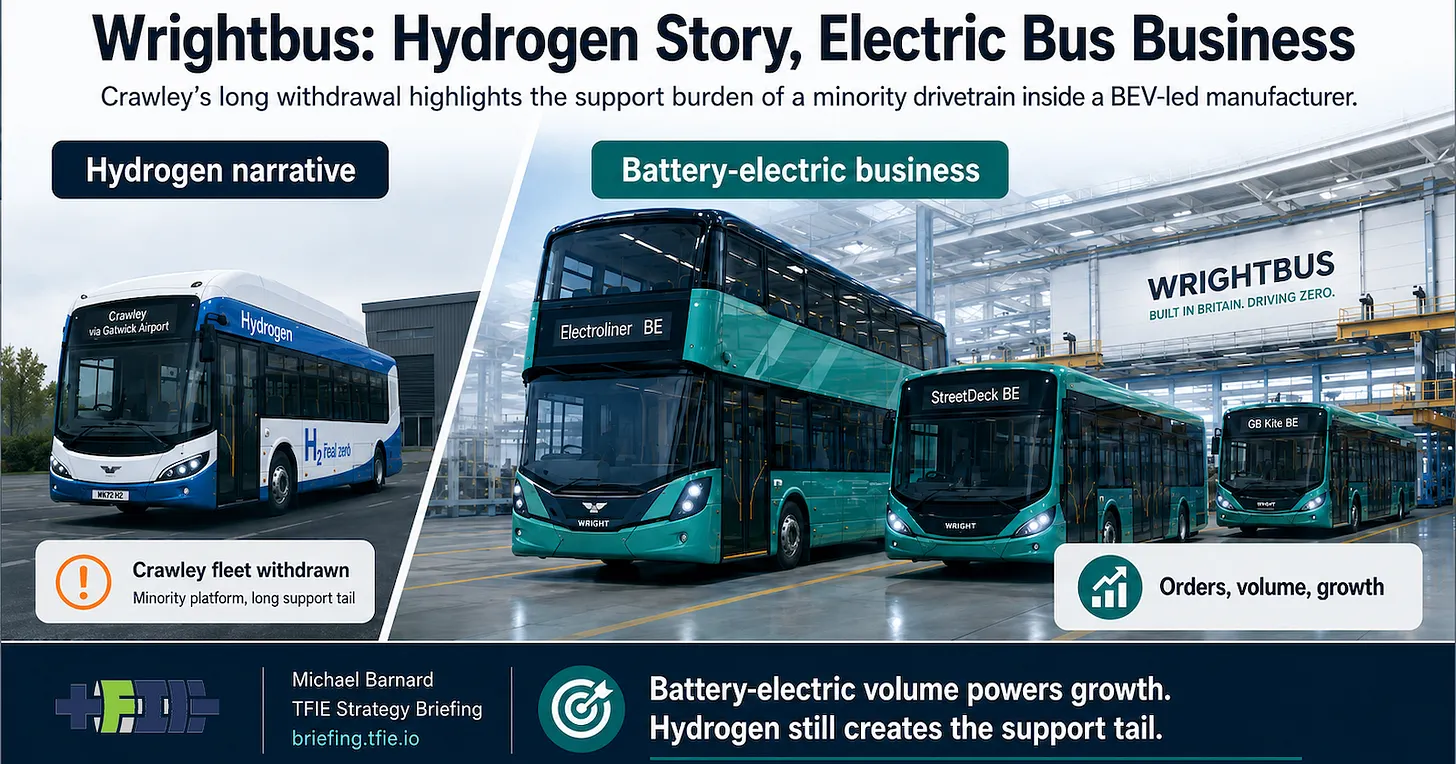
Wrightbus, a prominent bus manufacturer, is navigating a complex landscape where the initial enthusiasm for hydrogen-powered buses is increasingly giving way to a more established business in battery-electric vehicles. While the company's recovery and public image were significantly bolstered by its involvement in hydrogen technology, its commercial momentum and large-scale orders are now predominantly centered on battery-electric buses.
This shift is underscored by operational challenges faced by hydrogen fleets. A recent incident involving a hydrogen bus fire in Crawley, while under investigation, has highlighted the potential for specialized zero-emission fleets to create significant operational support problems. The withdrawal of a fleet of hydrogen single-deck buses from service in Crawley, even as a precautionary measure, has led to extended unavailability and the need for replacement vehicles. This situation emphasizes that for transit agencies, the immediate consequence of such incidents—service disruption and the need for backfilling—is a critical concern, regardless of the technical cause.
The operational reality for transit systems is far removed from the fanfare of launch events and policy narratives. Reliability, vehicle availability, maintenance capacity, and the robustness of fuel logistics are paramount. While all vehicle technologies have their faults, the support ecosystem for hydrogen fleets is described as thinner. A small, specialized hydrogen fleet requires a dedicated infrastructure for fuel supply, refuelling, specialized maintenance, and emergency procedures. This support structure becomes harder to justify when a manufacturer's primary commercial focus and order book are increasingly aligned with battery-electric buses.
Wrightbus's recovery story, which prominently featured hydrogen, was politically advantageous and aligned with broader industrial policy goals. However, the company's substantial fleet orders and visible commercial growth are now more strongly associated with its battery-electric offerings, particularly its Electroliner models. This does not signal an end to hydrogen bus production, but rather indicates that battery-electric manufacturing represents the scalable business. Hydrogen played a crucial role in making the recovery narrative compelling to policymakers and the public, but electric buses are now driving production volume, repeat procurement, and operational learning.
For policymakers, the lesson is to support domestic bus manufacturing by following the actual order books rather than relying on slogans. Industrial policy should focus on reliable zero-emission bus production, workforce development, supply chains, and charging infrastructure, with hydrogen being evaluated on its cost, reliability, infrastructure burden, and potential for repeat procurement. Transit agencies, in turn, must consider hydrogen bus procurements as long-term operational commitments, scrutinizing fuel supply, cost, refuelling system resilience, technician availability, and the depth of the supplier ecosystem.
BNN's Perspective: The transition from hydrogen hype to an electric bus business for manufacturers like Wrightbus reflects a pragmatic evolution driven by operational realities and market forces. While hydrogen technology holds promise for decarbonization, its widespread adoption faces significant hurdles in establishing the necessary robust and cost-effective support infrastructure. Battery-electric buses, despite their own challenges, appear to be on a more established path toward scalable deployment and operational maturity, benefiting from a widening supplier base and clearer learning curves. The focus for industry and policymakers should therefore be on supporting the technologies that demonstrate the greatest potential for reliable, widespread, and cost-effective zero-emission transit solutions.
Tags: Wrightbus, hydrogen bus, electric bus, battery-electric, zero-emission, transit, operational support, fleet, Crawley, Gatwick, Metrobus, refuelling, manufacturing, industrial policy, procurement, reliability, maintenance, infrastructure, service availability